Counterfeit Detection
A Guide to Spotting Counterfeit Currency
Design Features
What can be built into design elements to provide security against counterfeiting?
Designing a banknote is never a case of sitting down with a pen and paper and drawing something that looks attractive. It is desirable that as many components of the note as possible give some sort of counterfeit protection.
Many of the design features are built around precision printing that can be achieved by the highly specialised presses used in the production of bank notes. These can be extremely intricate.
Others rely on the type of print that can be produced e.g the tactile nature of intaglio print.
There are many types of design elements that can be worked into a bank note to give protection, and the following list refelcts a general sampling of these.
- Rainbow Printing
- Anti Copy Features
- See Through Features
- Microprinting
- Intaglio Detail
- Latent Images
- Blind Embossing
- Blind Recognition features
Rainbow Printing
In our simple analysis of a banknote we saw that for each colour printed during the litho process, a different printing plate is required. However this is not strictly true! It is possible to divide the ink duct feeding the printing plate into sections and place different colours side by side. During the printing process the inking rollers oscillate and this leads to a natural blending of the colours. This is called rainbowing.
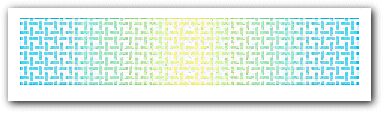
In our example we have a design that rainbows from blue to green to yellow to green and back to blue again. This can be achieved by having just blue and yellow ink in the ink duct. The green is caused by the yellow/blue blending.
Commercial printing presses are not designed for this type of procedure and hence rainbow printing not only adds aesthetic value to notes but also adds complexity to some counterfeiting techniques.
Anti Copy Features
Colour copiers and electronic scanners have become a major counterfeit threat in recent years and bank note producers have designed features that are not easily reproduced by these types of machines.
Anti copy features are generally composed of fine lines or dots and often have the word "VOID" or "FAKE" embedded within them. If copied these features are reproduced in a "distorted" form compared to the original, throwing up secret messages or interference effects.
See Colour Copier for further information
See Through Features
The precision equipment used to print back notes enables the back and front of the litho portions of the notes to be printed simultaneously. They can also be accurately registered to one another.
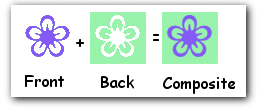
A feature utilising this accurate registration capability is the see through feature. It comprises of 2 different images, one on the front and the other on the back. When the note is held up to the light a third image is produced by the combination of each image.
Microprinting
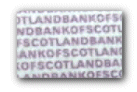
Tiny messages can be worked into designs and printed by both the intaglio and litho printing processes. With most, if not all counterfeiting techniques these tiny messages are lost, so in that respect they offer good protection.
Intaglio
Detail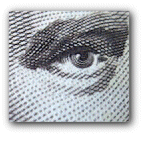
This is not strictly a design feature but the hand engraving mechanism by which intaglio images are initially generated produces such tonal variety and detail that it is in itself is a security feature.
Details such as those seen on the right are difficult to capture by any counterfeiting technique and as a results areas in which Intaglio is primarily used generally appear flatter and lacking in the tonal variety seen in an original.
Latent Images
Latent images are produced by intaglio print and the protection they offer is directly a result of the tactile nature of intaglio print. When viewed straight on, a latent image reveals nothing but lines...and that is if you look closely! But viewed at a glancing angle an image appears. This is a result of the intaglio print occluding the paper and creating a contrast.

Blind
EmbossingThe paper deformation that occurs during Intaglio printing is sometimes used as a feature in it's own right or can be used to produce an embossing effect of a feature produced by the lithographic process. It is also possible to produce inkless latent image effects using blind embossing.
Blind Recognition Features
It is often difficult for people with impaired vision to discriminate between one denomination and another and features have been developed to assist them. The features are often shapes printed in different colours. For example, a red circle might be used on a lower denomination, and a blue triangle on a higher denomination. Very often blind recognition features also have a tactile effect built into them.