Counterfeit Detection
A Guide to Spotting Counterfeit Currency
Counterfeit Threats
As technology marches on so do the ways in which a bank note can be counterfeited. What was once a highly skilled endeavor only possible by those who had access to suitable equipment, can now be accomplished rather too easily by anyone and at the press of a button.
There are essentially two approaches to producing a counterfeit :-
- Try and mimic the individual workings of a banknote, ie litho , intaglio etc
- Reproduce the note using the commercial half tone technique.
Individual Working Method
This method requires a high degree of skill from the counterfeiter.He/she will photograph an original note using a graphic arts camera and a variety of filters in an attempt to break the note down to it's component workings. This can be a complicated and arduous process requiring a lot of hand retouching to the films produced.
A printing plate will then be produced from each film and the printing process begun.
The paper is passed through the printing press again and again with each simulated working added each time, the printers ensuring that a register between each of the workings is achieved.
Another challenge facing the counterfeiter is the ink colour selection, with each colour being matched as closely to the original as possible.
HalfTone Technique
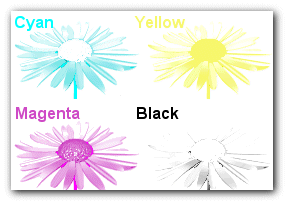
Pictures and graphics in magazines, etc, are reproduced by printing their half tone separations An original picture is electronically scanned and separated out into its cyan, yellow and magenta and black half tones. Half tone means that the image is now represented by dots, the size of the dot indicating how much particular colour is present. Cyan, yellow magenta and black are known as subtractive primaries and all colours can theoretically be created from them. In reality because of the limitations of the separation process and ink impurities this is not the case, and a black separation is also produced to provide colour corrections.
This mechanism is represented in the graphic below, a flower separated out to its cyan, yellow, magenta and black components.
 |
 |
This process of colour separations is fundamental to a number of counterfeiting techniques.
The Printed Half Tone Counterfeit
In this method the half tone separations from a scanner are written to film and then printed using their appropriate colour, ie cyan yellow magenta or black.
Colour Copier Counterfeit
A colour copier scans an original and performs the separations, the separations are then transferred to the paper using cyan, yellow magenta and black toners.
This type of counterfeiting is particularly dangerous because colour copiers are widely available and no real skill is required for their operation. Essentially you can press a button and have your counterfeit.
Because of the serious nature of the threat posed by colour copiers many of the new security features emerging, especially the "shiny" ones are aimed at preventing these types of counterfeits.
The colour copier manufactures are also acutely aware the threat their machines pose. As a result most copiers now incorporate anti counterfeit technology in an effort to prevent misuse.
As a counterfeit deterrent measure all copies made carry a unique code, allowing a copy to be traced to a particular machine. This is useful for assisting authorities determine where counterfeits have originated from.
Technology also exists to detect currency design elements which causes deliberate malfunction of the copier in terms of its output, or the shut down of the machine.
Computer Printers
With the advancement of computer technology it is a simple process to capture the image of a bank note and print it out on a desk top printer. Again these printers all create their images by combining cyan yellow magenta and black inks.
While this type of counterfeit requires a degree of computer skill, it is not rocket science.